

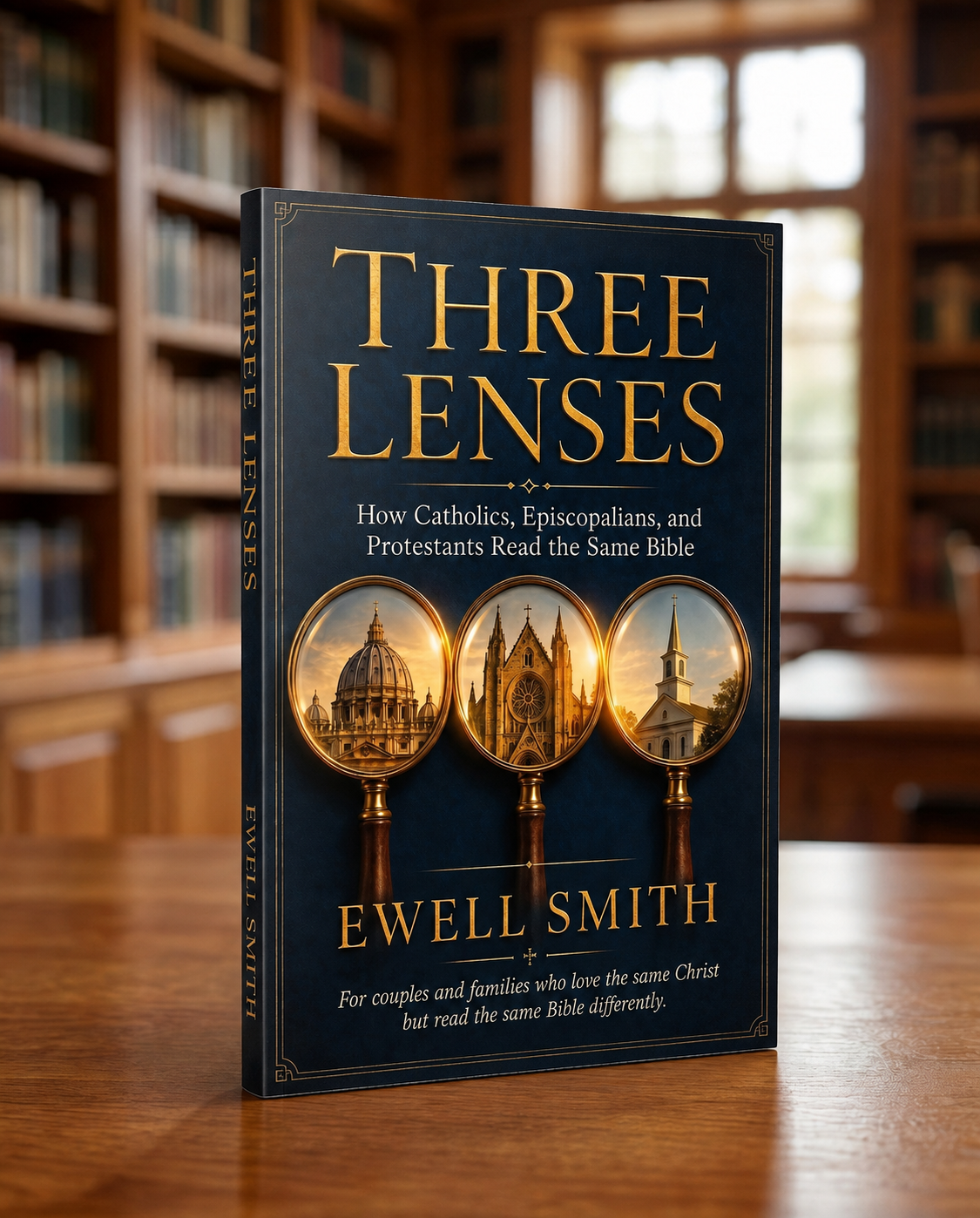
WHY FAITHFUL CHRISTIANS READ THE SAME BIBLE DIFFERENTLY
One Christ. One Bible. Three Lenses.
An accessible, respectful guide for couples and families who love the same Christ but sometimes understand the same Bible differently.
THE QUESTION BEHIND THE BOOK
How can faithful Christians read the same Bible
and reach different conclusions?
For couples and families from different Christian traditions, those differences are not merely theological. They can surface at weddings, baptisms, the Communion rail, and around the family dinner table.
Often, we understand what our own church teaches without really understanding why another Christian tradition sees the same question differently.
Three Lenses places Catholic, Episcopal, and Protestant perspectives side by side, not to declare a winner, but to help Christians understand what each tradition believes and how it arrived there.
WHO HAS AUTHORITY?
WHAT HAPPENS IN COMMUNION?
HOW IS SALVATION UNDERSTOOD?
An Interactive Preview
See the Three Lenses in action.
I wrote this book because people I love read these very passages differently than I do, and I wanted to understand why. Try one below and see what I mean.
Choose a Scripture passage below to see three Christian perspectives, where they share common ground, and why their interpretations differ.
“You are Peter, and on this rock I will build my church, and the gates of hell will not overcome it. I will give you the keys of the kingdom of heaven; whatever you bind on earth will be bound in heaven, and whatever you loose on earth will be loosed in heaven.”
Matthew 16:18–19
Catholic Lens
Catholic interpretation begins with the Aramaic word Kepha, meaning rock, the same word used for both Peter’s name and the foundation Jesus describes, so the text does not separate the man from the metaphor. The passage is read through the pattern of Isaiah 22, where a royal steward held the keys of the house of David as an office that outlived any one steward. Catholic interpretation understands Jesus as establishing a similar office, not merely honoring Peter personally, and each Bishop of Rome inherits Peter’s office, not his personal qualities. Early writers such as Irenaeus pointed to Rome as a touchstone of orthodoxy, and Catholic teaching sees this as a visible, durable way the Church has preserved unity across every generation since.
Episcopal Lens
Anglican or Episcopal teaching notices that two chapters later, in Matthew 18, Jesus gives the same binding-and-loosing authority to the whole group of disciples, and John 20 extends this further when the risen Christ breathes on all of them together. In this interpretation, Peter speaks first as the natural spokesman of the group, but the keys belong to the whole apostolic college rather than to him alone. Historically, when the early Church faced its most serious crises, questions about the nature of Christ and the Holy Spirit, it resolved them through councils rather than papal decree, with the Bishop of Rome honored as first among equals. Anglicanism keeps the historic offices of bishop, priest, and deacon, with authority exercised through the college of bishops.
Protestant Lens
Many Protestants understand an apostle as someone who was an eyewitness to the risen Christ, a foundational role that is laid once rather than repeated, the way a building’s foundation is poured once and then built upon. Peter exercised his keys concretely in Acts, opening the faith to Jewish believers, Samaritans, and Gentiles. Paul writes that no one can lay a different foundation than the one already laid, and that the Church is built on the foundation of the apostles and prophets, with Christ as the cornerstone. In this interpretation, later generations build on that foundation rather than inherit it. Early writers including John Chrysostom read the rock as Peter’s confession of faith rather than his person, a reading the Eastern churches have long shared.
Shared Ground
All three traditions agree that Peter occupies a unique and prominent place among the apostles, and that the passage describes real authority, not merely symbolic honor. None of them diminish him. All agree that the Church Jesus promises to build is one Church, and that how it is structured and governed matters enormously for how it carries out its mission in the world.
Why They Differ
The disagreement is not about whether authority exists in the Church, but about where it ultimately resides: in an office held by a single successor, in the apostolic foundation completed once and preserved in Scripture, or in the college of bishops exercising authority together through conciliar governance. Each answer shapes how a tradition settles disputes and defines unity.
The same Bible. Three lenses. Draw your own conclusions.
“Unless you eat the flesh of the Son of Man and drink his blood, you have no life in you. Whoever eats my flesh and drinks my blood has eternal life… For my flesh is real food and my blood is real drink.”
John 6:53–56
Catholic Lens
Catholic interpretation treats this moment as the interpretive key to the whole passage. When the crowd found this teaching a hard saying and many turned away, Jesus did not call them back to explain he had spoken in metaphor, the way he clarified misunderstood parables elsewhere. As the discourse continues, the Greek shifts from the ordinary word for eating to a more vivid word carrying the physical sense of chewing, read as moving toward something more concrete rather than less. This passage is understood as describing, before it was formally instituted, what happens at every Mass: the bread and wine becoming the actual body and blood of Christ, not a symbol that merely represents his presence.
Episcopal Lens
Anglican or Episcopal teaching holds that Christ is truly present in Communion while being careful not to define exactly how that presence works. The Thirty-Nine Articles affirm that his body is truly given and received, rejecting the idea that Communion is merely symbolic remembrance, while generally declining to define that presence through the Catholic doctrine of transubstantiation. To feed on Christ means to trust him and be sustained by him in a way that is genuine even when it resists simple explanation. Within Anglicanism, some emphasize the objective reality of Christ’s presence more strongly, closer to Catholic teaching, while others emphasize personal faith more strongly, closer to Protestant teaching, and the tradition holds both together.
Protestant Lens
Many Protestants read this passage as primarily about saving faith rather than the sacrament of Communion. Jesus says that whoever comes to him will never go hungry and whoever believes in him will never be thirsty, setting coming and believing side by side as the same act; eating and drinking are read as another way of describing that same trust. Near the end of the passage, Jesus says the flesh counts for nothing and that his words are spirit and life, read by many as the key to the whole conversation. Within Protestant Christianity, some traditions, particularly Reformed and Lutheran churches, understand a fuller presence of Christ in Communion than Baptist and evangelical traditions typically do.
Shared Ground
All three traditions affirm that Jesus is the bread of life in the deepest sense, the source of eternal life that human beings cannot provide for themselves. All affirm that faith is essential, and that a person who does not trust in Jesus has not received what he is offering, whatever else this passage teaches about how that offering reaches the believer.
Why They Differ
The central difference is whether John 6 primarily describes sacramental participation in Christ, receiving Christ through faith, or a mystery in which sacramental and spiritual realities remain joined without precisely defining how. Those different starting points shape whether Communion is understood as Christ’s body and blood, a means of receiving his presence, or a symbolic act centered on faith and remembrance.
The same Bible. Three lenses. Draw your own conclusions.
“It is by grace you have been saved, through faith… not by works, so that no one can boast… For we are God’s handiwork, created in Christ Jesus to do good works.”
Ephesians 2:8–10
Catholic Lens
Catholic interpretation reads salvation as a lifelong process of genuine interior transformation rather than a single legal declaration. Justification means more than being declared righteous from the outside; God pours grace into the soul, beginning a real transformation the believer cooperates with throughout life. Grace is entirely primary, given most fully through the sacraments, beginning with baptism. Catholic teaching rejects a faith understood as separated from love and lived obedience. The Catholic tradition draws on Paul’s phrase about faith working through love, the kind of faith that saves. In this interpretation, justification and sanctification are not separate events but one continuous movement, and the Council of Trent taught that the saved person is not just declared clean, but is being made clean.
Episcopal Lens
Anglican or Episcopal teaching holds Protestant convictions and Catholic instincts together. Article Eleven of the Thirty-Nine Articles states that a person is accounted righteous before God only for the merit of Christ, by faith, language that reflects the Reformation emphasis within Anglican teaching. Yet Anglicanism is also deeply sacramental, and saving grace is understood to be communicated through baptism and the Eucharist, not merely a reminder of grace already received. Evangelical and low-church Anglicans align closely with Protestant teaching on personal conversion, while Anglo-Catholic and high-church Anglicans read salvation closer to Catholic understanding, emphasizing the interior transformation grace produces. Most Episcopalians hold both convictions together, reflecting the view that Scripture, tradition, and reason illuminate a truth larger than any single formula.
Protestant Lens
Many Protestants read justification as a legal act: God declaring a guilty person innocent, not because they have already changed, but because Christ’s own righteousness has been credited to their account, the way a debt might be paid in full by someone else on a person’s behalf. The verdict, in this understanding, is final. Martin Luther described the result as being simultaneously saint and sinner, fully righteous in God’s sight yet still growing and struggling in their own nature. Faith is not a contribution but the empty hand that receives a gift already given. Good works are not rejected but relocated, the fruit of justification rather than its cause, the way a healthy tree produces fruit without the fruit making the tree alive.
Shared Ground
All three traditions teach that human beings cannot save themselves, that grace comes first, and that faith is essential to receiving it. All also teach that a genuinely changed life, marked by good works, must follow authentic faith, even though they explain the relationship between grace, faith, and works differently and place the emphasis in different places.
Why They Differ
The central difference is whether justification itself includes the believer’s interior renewal or is God’s declaration of righteousness received through faith, with renewal following as sanctification. The traditions also differ over whether good works cooperate with grace within the process of salvation or necessarily follow salvation as its evidence and fruit.
The same Bible. Three lenses. Draw your own conclusions.
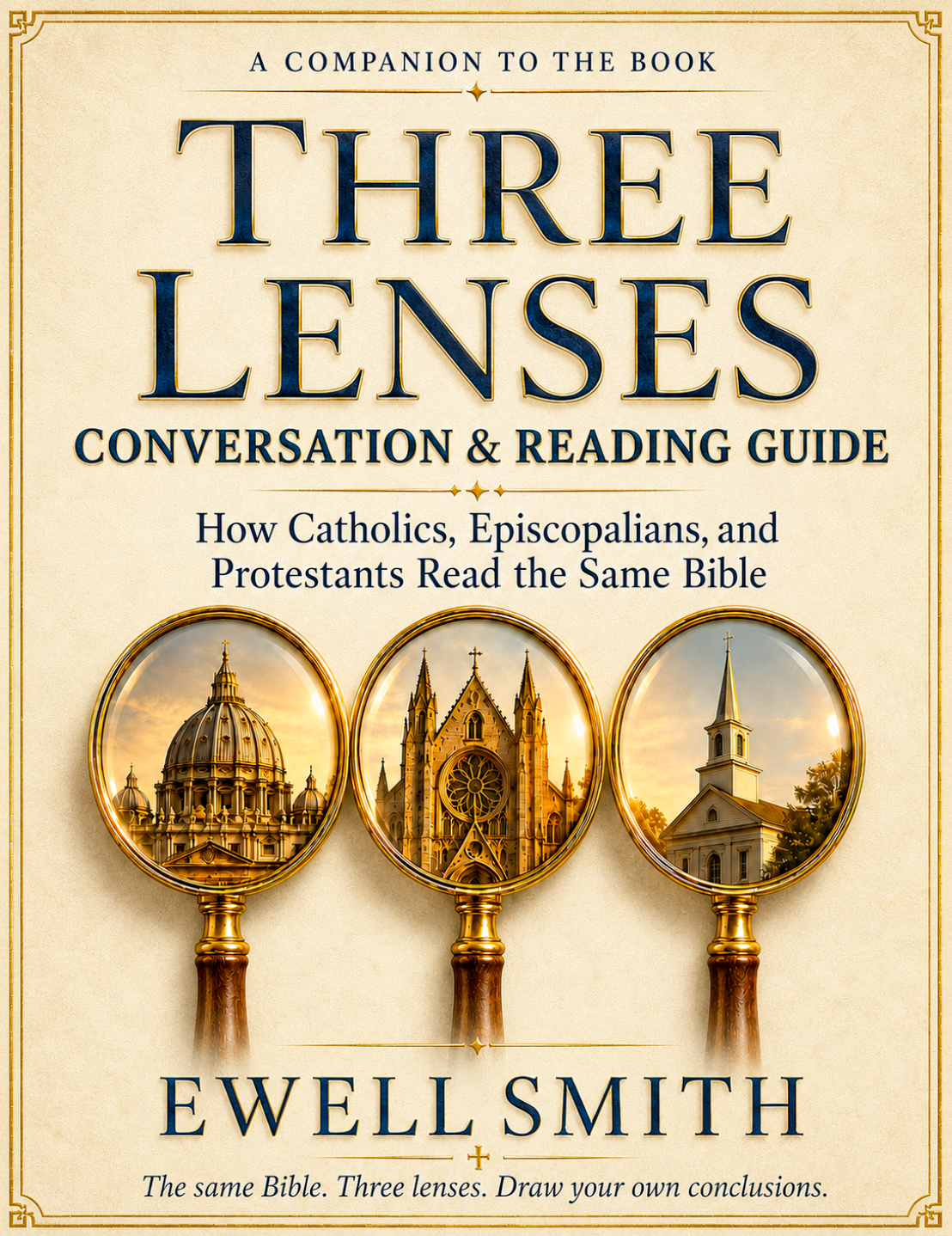
Take the conversation further.
Explore the questions, reflect on what you've read, and start meaningful conversations about faith with family and friends.
MY SINCERE HOPE
Appreciate your faith more deeply.
Understand others more clearly.
My sincere hope is that this book helps you better appreciate your own faith, understand why other Christians see important questions differently, and bring more grace to the conversations that matter most.